20+ years of operational expertise
Zakk and Taylor have each spent over a decade working with startups and small businesses, the 3-to-50-person range, to improve how they operate.
Want to find the highest-leverage places to put AI to work in your business? Tell us a little about the outcome you are trying to create.
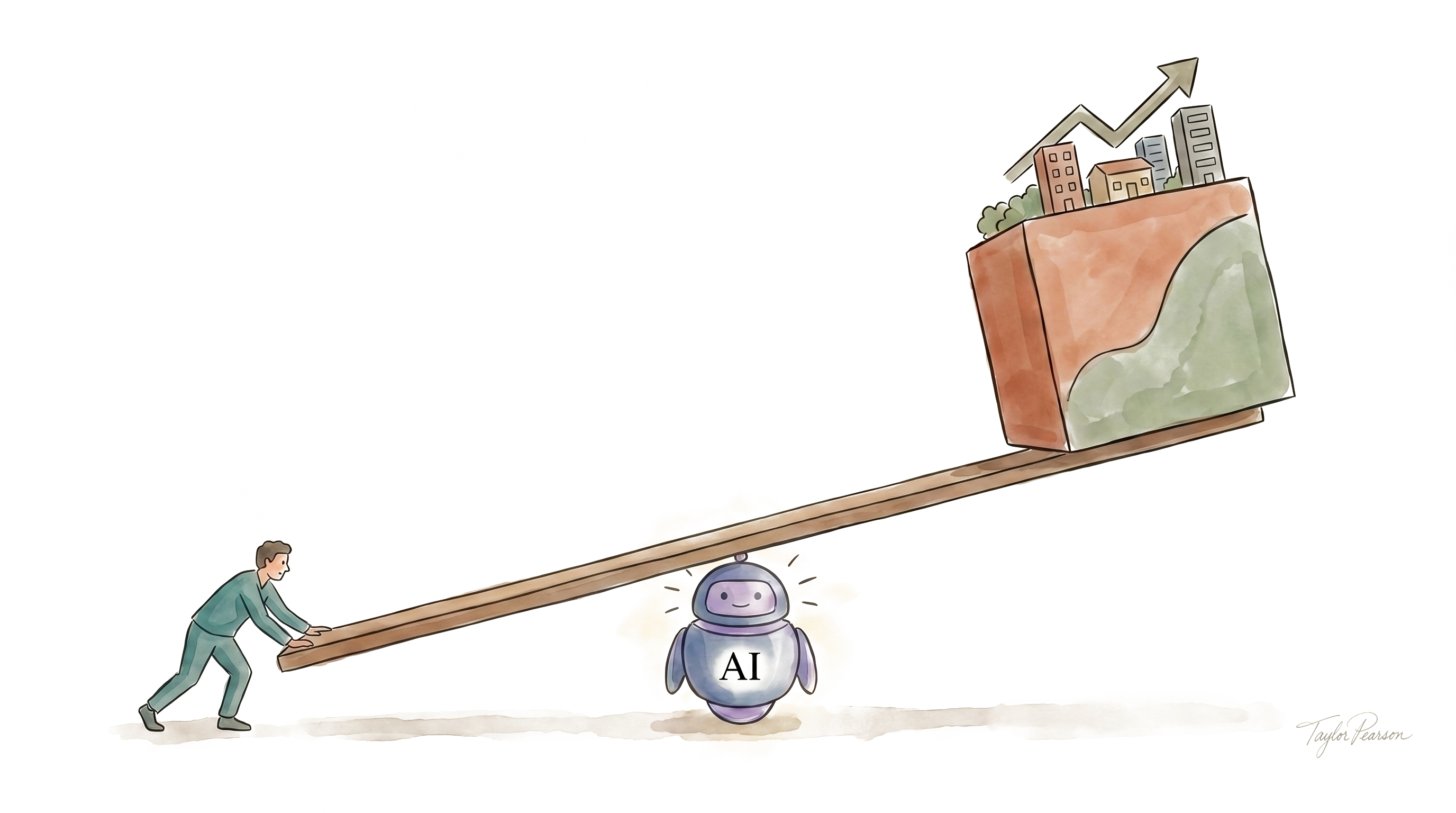
Zakk and Taylor have each spent over a decade working with startups and small businesses, the 3-to-50-person range, to improve how they operate.
Both have been building AI systems from an operations-first perspective from the start, not just theorizing about them. Zakk has spent thirteen years building and leading engineering teams, so we can take the diagnosis all the way to a fully operational system.
You are good at something, and that is why the business exists and works. You close the accounts, make the call on every product, or know what the customer wants before they do.
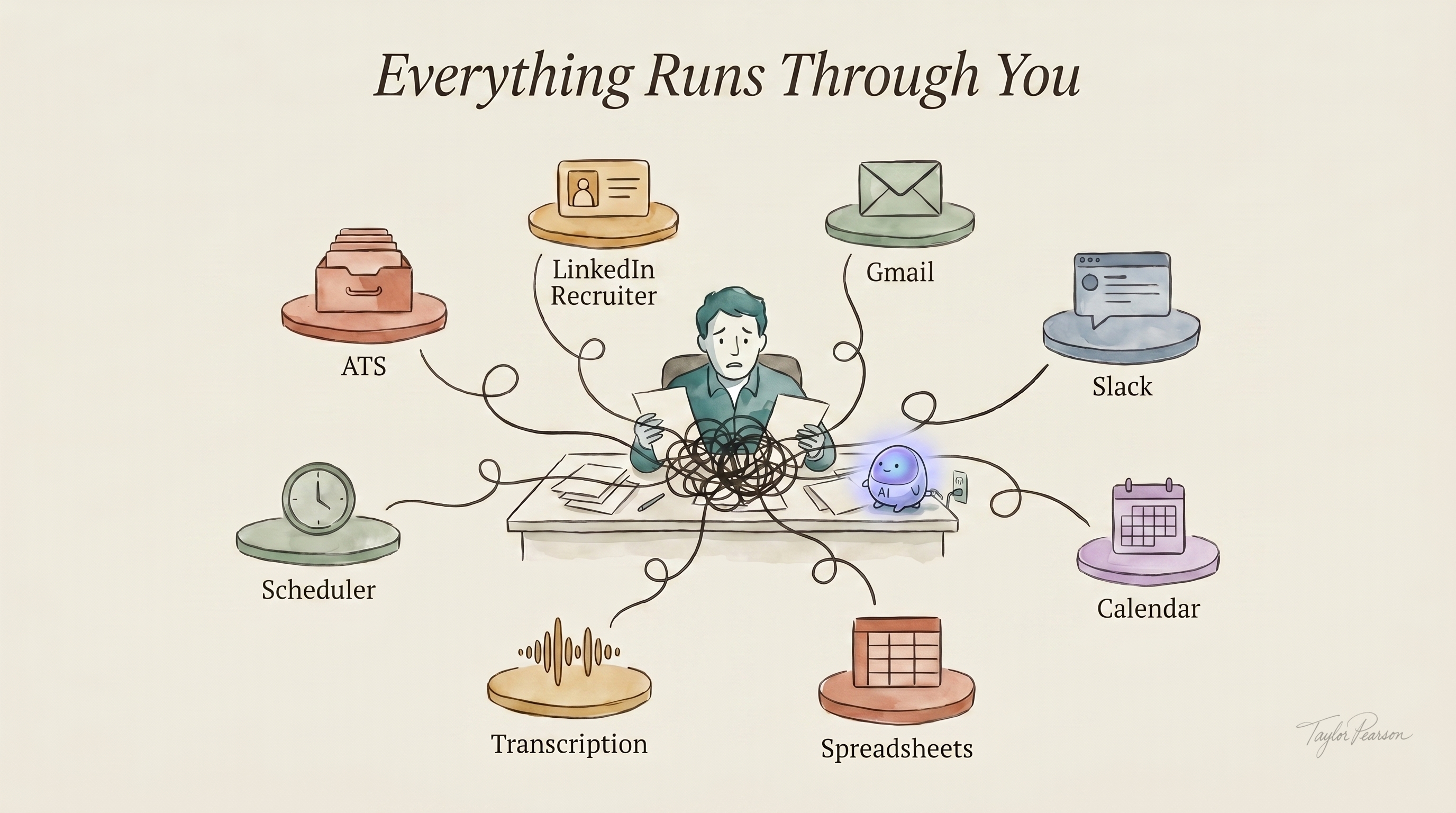
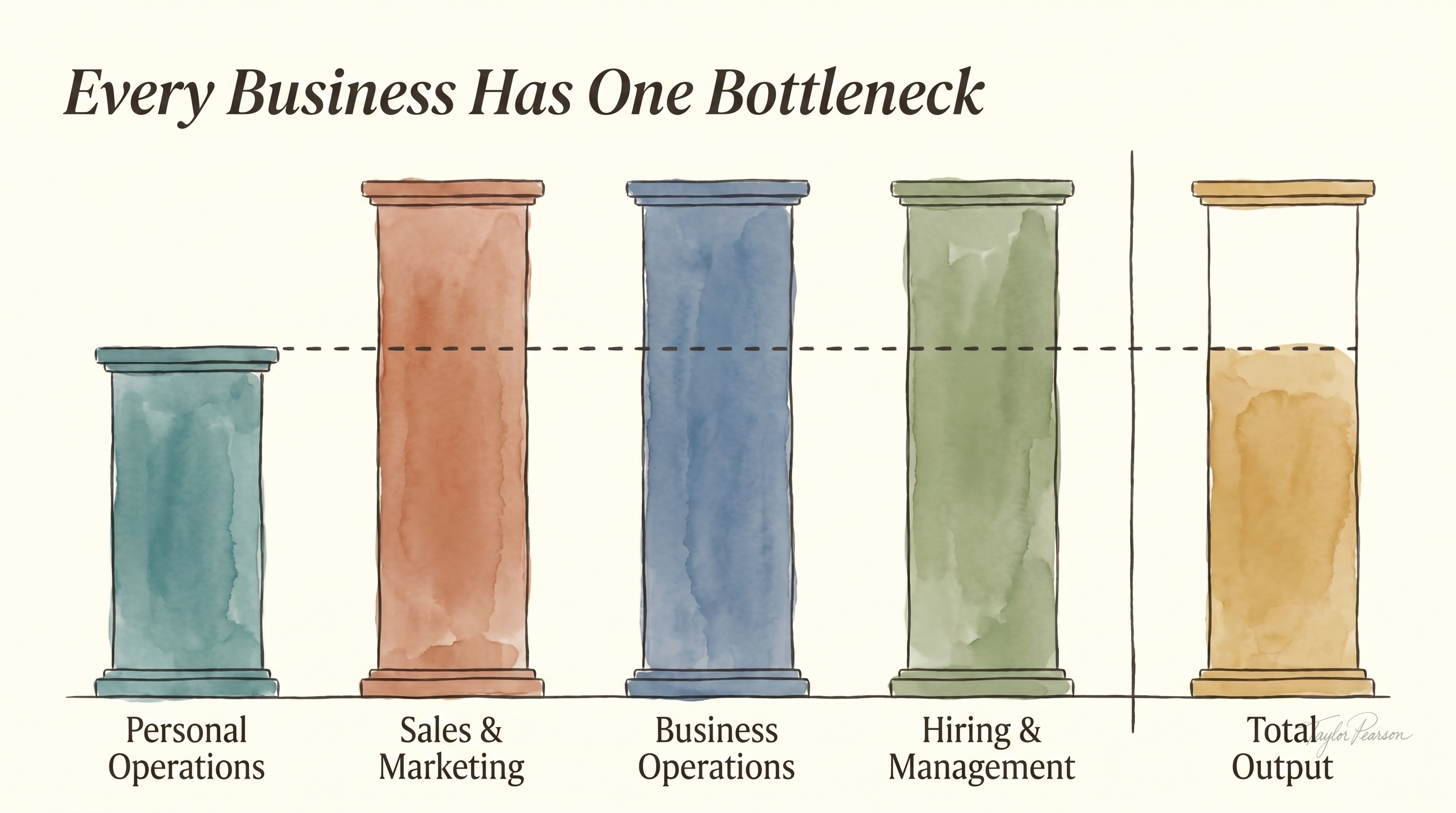
This is the classic growth pattern: you are a founder or key team member that makes the business work, and you are also the constraint. It cannot grow past your calendar and you cannot take a month off.
To scale the business or get back your time, you need systems that let it work without you and make your team more effective. What worked when you started starts to break as you scale.
Same pattern, different business
Change the business and the shape of the problem is identical. A founder running a small investment platform has incoming deals to screen, investors to profile, and documents moved by hand between systems.
You are using it as an accessory rather than as an operating system.
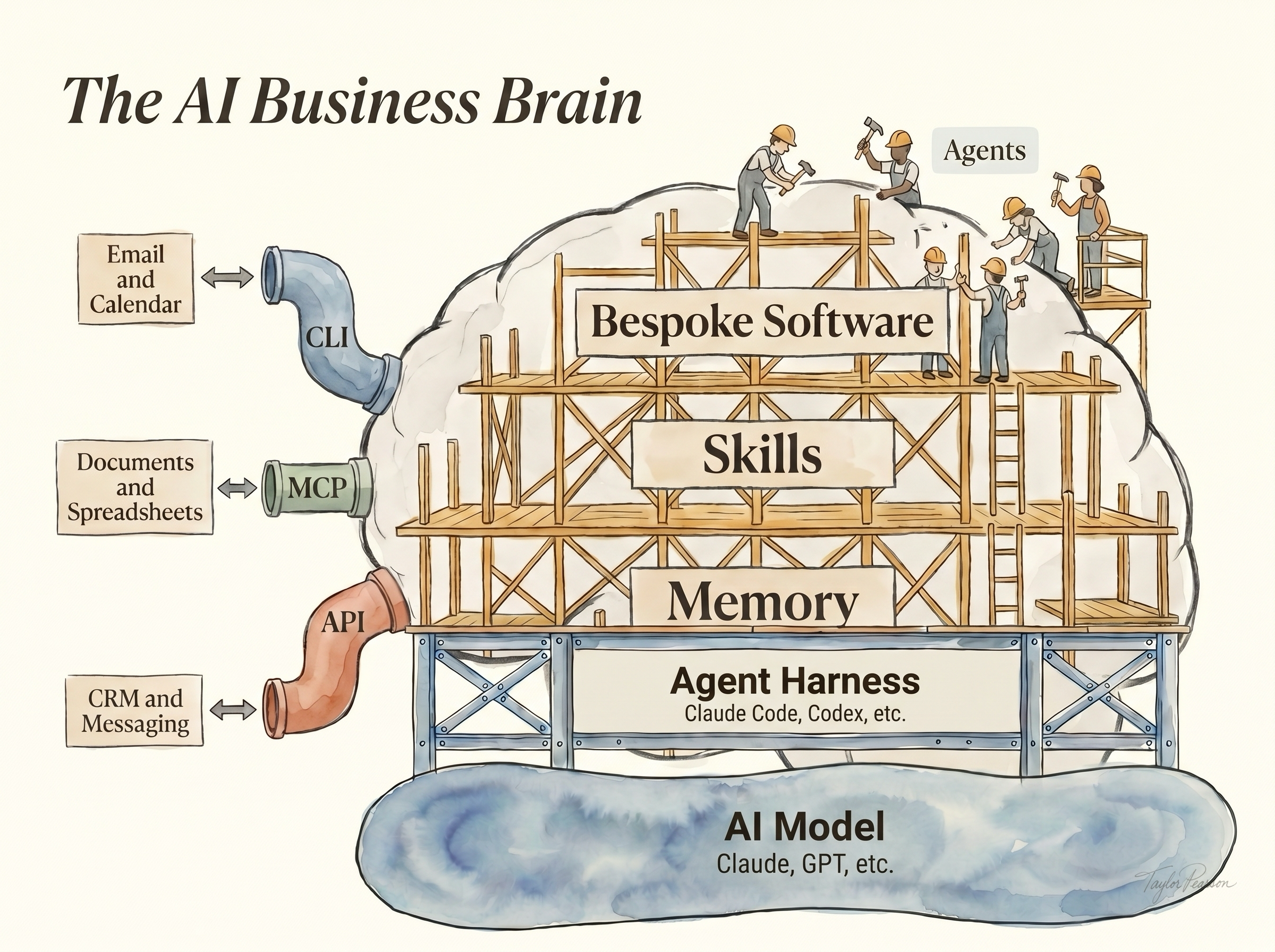
Most of the discussion is about the newest AI models. The real leverage is the layer you build on top.
Memory that holds your business: your customers, your market, the way you make decisions.
Skills your procedures written for an agent instead of an employee.
Small custom tools for the work that has to come out the same every time.
That is an AI business brain, not just a tool. It is the part that compounds into process power: the kind of advantage a competitor cannot copy.
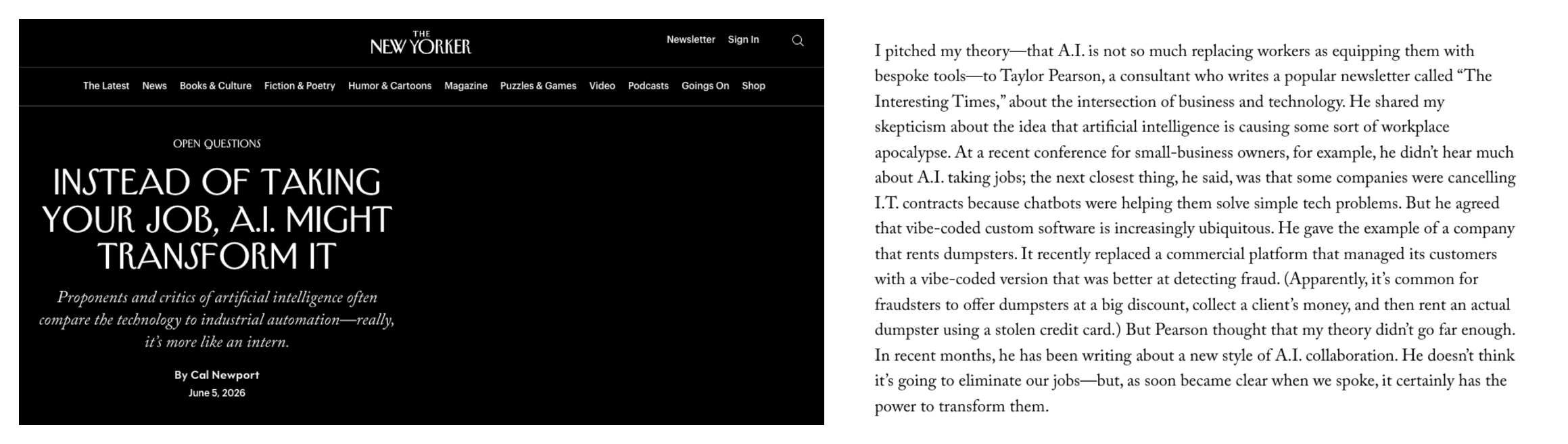
Cal Newport interviewed Taylor for his New Yorker column on how AI is reshaping knowledge work, and the piece's argument, that AI is equipping knowledge workers with bespoke tools, is exactly the layer we install.
Read the pieceA major problem with implementing AI is that it has jagged intelligence. It can provide a ton of leverage in certain contexts, but be useless, if not actively harmful, in others.
Every business also has different needs and bottlenecks. Automating a process with no business value is worth nothing.
Over the course of a month, we work with you and your team across a few working sessions where you describe, in plain English, how your business actually works.
Installing an operating system the old way is measured in quarters. A custom software project is measured in months and six figures. Our goal is to get the first working piece of your system in front of you in weeks.
Picture the repetitive work running in the background: the intake, the reporting, the document handling, the follow-ups, all happening with your team approving outputs instead of producing them from scratch.
Your own role changes more than theirs. You build a procedure once and it runs every week, across every client, without you in the loop. The business gets faster without getting heavier.
That is the thing you are actually buying: operating leverage. Your time, converted back into the work only you can do.

Taylor has spent over a decade coaching and consulting with founders of $1-10M companies through exactly this kind of constraint diagnosis, using the Theory of Constraints as the method. He has been heads down for the last two years on how to use AI to do it even better.

Zakk has spent thirteen years building and leading engineering teams and helped two companies grow from two people to fifty, shipping the kind of production systems where reliability matters. He has since pointed all of that at AI for businesses like yours.
Render unto software that which is deterministic, unto the agent that which is probabilistic, and unto yourself that which is irreducibly yours.
We map your actual workflow and sort it into the parts AI does as well or better than a person, the parts that still need a human, and the handoffs between them. Done right, the team and the AI together outrun either one alone.
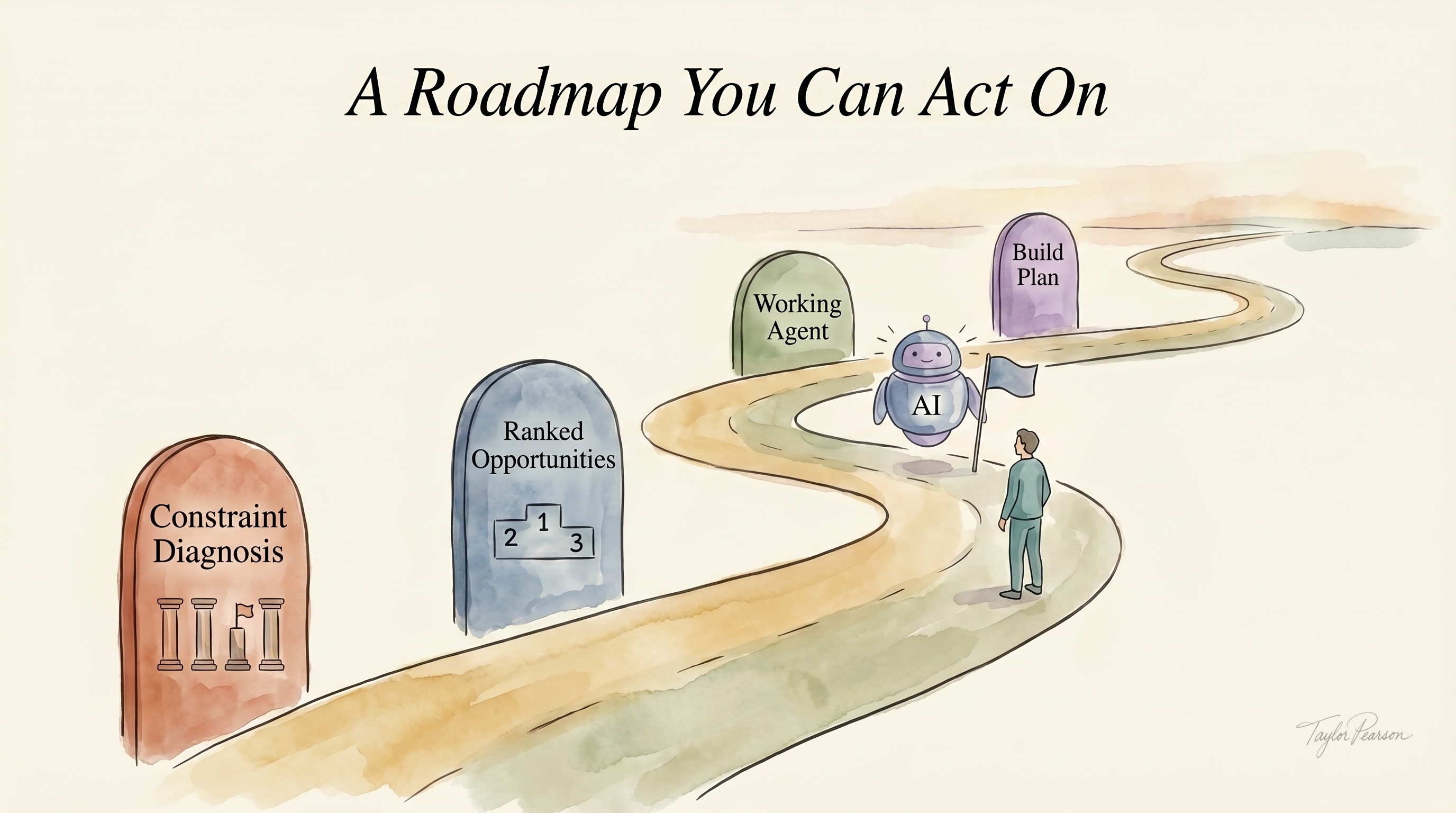
A diagnosis of your largest binding constraints so every dollar you put toward AI aims at the value driver, not at busywork.
The highest-leverage places to put AI to work, ranked by payoff and build effort, so you fix the constraint instead of the annoyance.
A working implementation of your highest-leverage use case.
A build roadmap, so you can implement more high-leverage uses.
You and the relevant people on your team walk us through the recurring work, the tools it touches, and the decisions that matter.
You pressure-test what we find with the context only you have. We identify the binding constraint, rank the opportunities, and choose one bounded use case to build now.
You use an early version on real inputs and tell us where it helps or breaks. We build and refine a work agent inside the way your team already works.
You review the working system and decide what is worth doing next. We hand you the finished roadmap: the constraint diagnosis, ranked opportunities, architecture, and build plan.
There is some adoption. Someone on your team needs to develop an intuition about AI and some of the basic components. We'll help enable that.
But not everyone needs the same relationship with it. The person who wants to get close to the machinery can work in Claude Code or Cowork, building or tuning the skills. Everyone else can use it in Slack, your CRM, or the tools where they already work: ask questions, hand it a job, or review what it produces.
We design that interaction model around the people and their roles. The goal isn't a zero-change rollout; it's the right amount of change for each person, so the system earns its place in the team.
Steam factories were tall and narrow because one big engine turned line shafts along the ceiling. Machines had to sit close to the shafts, and materials had to be hauled up and down between floors. When electricity arrived, the first thing factory owners did was replace the steam engine with one big electric motor and keep the same shafts. The motor was better, but the factory was still organized around the old constraint.
The real unlock came when each machine got its own small motor. Now the source of power no longer determined the layout; the flow of the work did. Factories could be organized as production lines, with each step next to the one it fed. That reorganization, not the motor itself, is where the productivity gains came from.
Using ChatGPT or Claude in a browser tab is like swapping in the electric motor. It can make isolated tasks faster, but the business still has the same handoffs, the same people moving information between tools, and the same owner in the middle. We help reorganize the factory around AI: memory, skills, small tools, and agents built around the flow of your actual work. That gives you two things:
The big models eat the generic, codifiable parts of the work: the stuff that looks the same for everyone. What they can't eat is the local, fast-changing layer: your clients, your constraints, the decisions you made and why.
Building that means the next model only makes your system more powerful. The model underneath is available to everyone. The operating system built around your business is yours alone.
You probably could. Tell us about your business and you can evaluate whether it makes sense to do it yourself. We're open to either path.
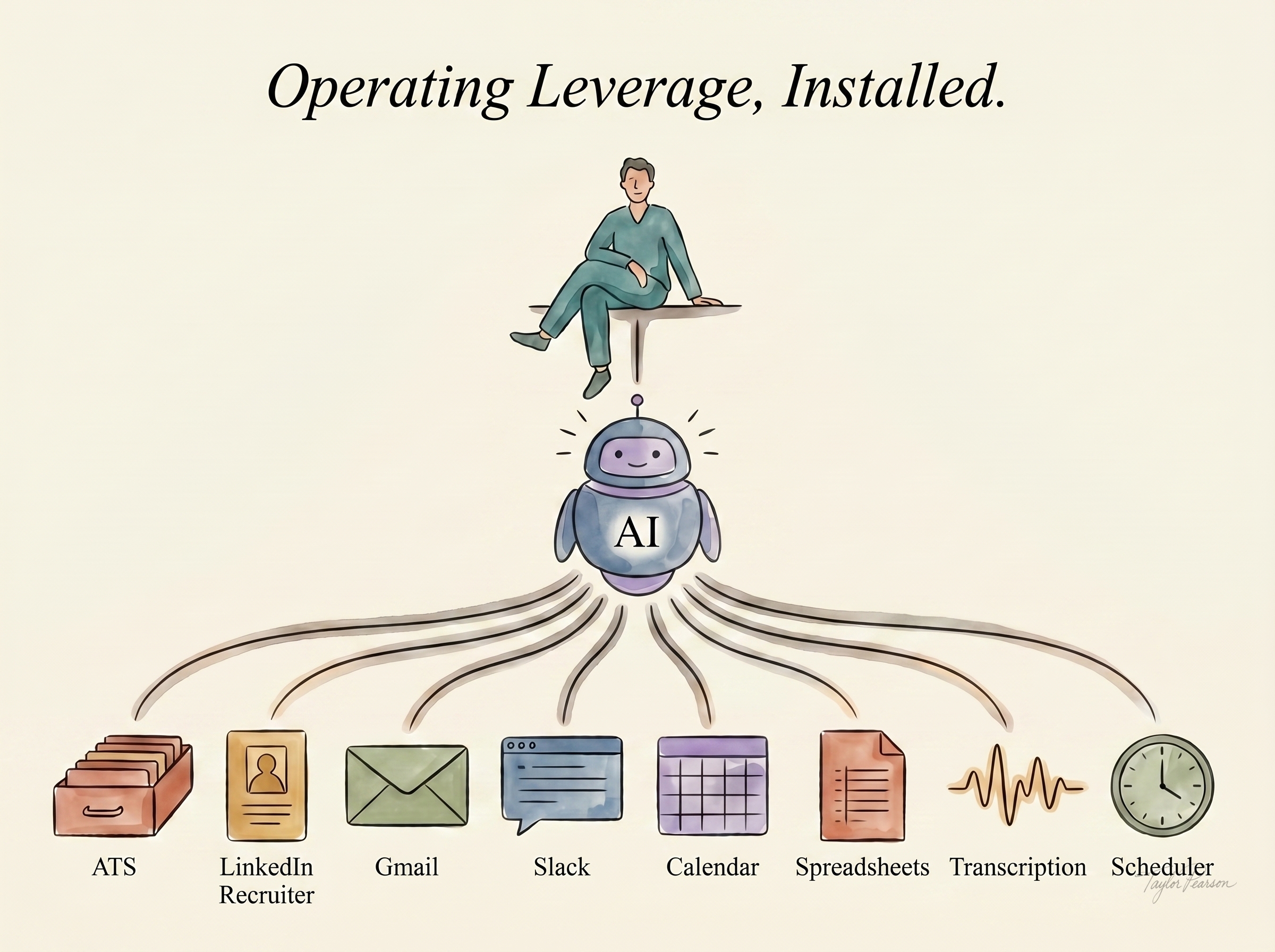
Here is what this looked like at an executive recruiting firm. Its team works across LinkedIn Recruiter, Gmail, Slack, an applicant-tracking system, call transcripts, and spreadsheets, with more than seventy thousand candidate records underneath it all.
This is how AI starts to generate leverage inside a business. It is not a chatbot off to the side, but a system wired into the real work, giving time back first and then doing what could not be done before.
This is not for aspiring founders or AI hobbyists. It is for people running a real business who want the output of a bigger team without hiring one.
If we work together, we will build an AI Operating Leverage Roadmap.
A diagnosis of your largest binding constraints so every dollar you put toward AI aims at the value driver, not at busywork.
The highest-leverage places to put AI to work, ranked by payoff and build effort, so you fix the constraint instead of the annoyance.
A working implementation of your highest-leverage use case.
A build roadmap, so you can implement more high-leverage uses.
A work agent for your highest-leverage opportunity, wired into Slack, plus an implementation working session after your roadmap is delivered.
We are taking on three companies to start. This is an involved process and we want to get it right before we scale it to others.
You will walk away with a few good ideas worth running with, whether or not we end up working together.
A short form — if it's a fit, we'll set up a free 60-minute diagnostic call. You'll leave with a few good ideas either way.
Fill out the form and tell us what you are trying to create. We review every inquiry personally. If it looks like a fit, we'll get in touch to set up a free 60-minute diagnostic call.
A few years from now this will not be an edge. Every business in your category will run on some version of it, the way they all eventually got websites and a CRM. The advantage goes to whoever builds the understanding first, because the context compounds.
Start here
Start with the short form. Tell us what you are trying to create, and we will follow up with the right next step if it looks like a fit.
Have a question before you submit? Email Taylor.
For some businesses, the roadmap is the start of something longer. Once you can see the map, the natural next step is the build, installing the system. We will talk to you about whether that is something you want to manage or we can manage it for you.